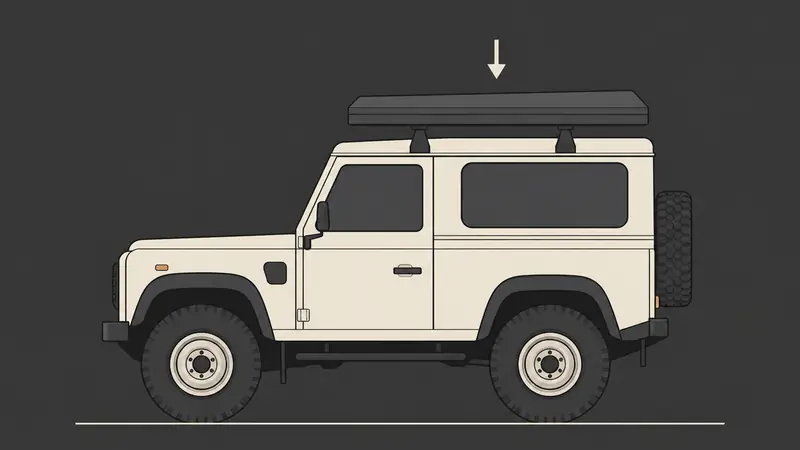
Two ratings govern your roof: the dynamic (driving) limit, typically 100 to 165 lbs, and the static (parked) limit, several times higher. An occupied rooftop tent at camp counts against the static number, so sleeping in it is fine. Driving is where setups fail: your limit is the lower of the rack's dynamic rating and your vehicle's roof rating, and the rack's own weight counts against it.
The panic usually starts in the owner's manual. It says the roof is rated for 150 lbs, the tent you want weighs 130, and then two adults are supposed to climb in and sleep up there. That is 490 lbs on a 150 lb roof, so the whole idea must be unsafe, right? Wrong number. The manual figure is a driving limit. Parked at camp, your roof plays by a different rating entirely, and it is several times more generous. The real risk in an RTT setup is not the night at camp. It is the drive to get there.
What is the difference between static and dynamic roof load?
The dynamic rating is the maximum your roof and rack can carry while the vehicle is moving. The static rating is what they can hold while parked. Yakima rates its crossbar systems at 165 lbs dynamic but up to 600 lbs static, and that gap is most of the answer to the rooftop tent question.
Why so far apart? Inertia. A load that presses down with 165 lbs sitting still hammers the mounting points with several times that force when you hit a pothole at speed or swerve around a deer. The static case has no such multiplier: the load just sits there, spread across the bars. The static rating commonly runs about four times the dynamic rating, the convention our calculator's defaults follow, though the exact multiple varies by maker, so use your rack's published static number. Front Runner rates its Slimline II tray at 660 lbs (300 kg) static and declines to publish a single dynamic figure at all, because the safe moving load depends on speed, road surface, and how the weight is spread.
| Rating | When it applies | Typical range |
|---|---|---|
| Dynamic | Vehicle moving — your driving limit | 100–165 lbs (vehicle roofs); 165+ lbs (aftermarket racks) |
| Static | Parked — tent deployed, people inside | ≈4× dynamic (Yakima 600 lbs, Front Runner 660 lbs) |
Is it safe to sleep in a rooftop tent?
Yes, provided your rack's static rating covers the rack, the tent, and everyone in it, and on common systems it does. An 85 lb rack, a 145 lb tent, and two 180 lb adults come to 590 lbs, sitting parked, against a 661 lb static rating. The forum math that stacks occupants against the 150 lb manual figure is comparing a camping load to a driving limit that does not apply while you sleep.
That is not a free pass. The static rating assumes the load is spread across properly torqued crossbars within the maker's spacing spec, and factory bars on many vehicles are not rated for RTT use at all. Check the tent maker's crossbar requirements. But the basic fear, that a roof rated 150 lbs will cave under sleepers, mistakes which of the two numbers is on duty.
Your real driving limit is the smallest number in the stack
On the road, three ratings stack between you and trouble: the vehicle's roof rating, the rack's dynamic rating, and the mounts connecting them. The binding limit is the lowest of them, and everything on the roof counts against it, including the rack itself. A 60 lb steel rack has spent 40 percent of a 150 lb roof budget before the tent goes on.
Run the numbers on a typical build: an 85 lb rack, a 145 lb tent, and 50 lbs of gear is 280 lbs total. Against a 165 lb dynamic rating that is 170 percent, over the driving limit by 115 lbs, yet only 42 percent of a 661 lb static rating. That rig is safe to camp in and unsafe to drive, which is exactly the trap: nothing feels wrong in the driveway, and the failure mode is fatigue at the mounts that shows up at speed, miles later.
How much do rooftop tents actually weigh?
Softshells mostly land between 100 and 160 lbs: Thule's Tepui Foothill is 108 lbs. Hardshells run heavier, roughly 120 to 200 lbs: the iKamper Skycamp 3.0 is 165 lbs, and Roofnest's Falcon line spans about 130 to 170 lbs.
Put those weights next to the dynamic ratings above. A hardshell alone can meet or beat a 150 or 165 lb driving limit before the rack and the recovery boards are counted. Most setups that go over do it here, in the tent-plus-rack stack, without anyone doing anything that feels reckless.
Does off-road driving change the math?
Yes, downward. Rhino-Rack publishes separate on-road, off-road, and static ratings, and states plainly that loads measured on the roof off-road are far greater than during general on-road driving. Corrugations turn a steady 150 lb load into repeated momentary spikes well beyond it.
Most US-market rack pages never mention this, so if you spend real time on washboard, look up whether your maker publishes an off-road figure (Rhino-Rack has a per-vehicle calculator) and leave headroom under the dynamic limit either way. Our calculator flags a warning at 80 percent of the dynamic rating or higher for the same reason: the rated maximum assumes pavement.
What a roof load does to handling
Even inside every rating, roof weight changes how the vehicle drives. NHTSA's rollover star ratings are built on the Static Stability Factor, track width divided by twice the center-of-gravity height, per the National Academies' review of the rating system. Every pound you add at roof height raises that center of gravity and lowers the one factor the rollover rating is built on.
The practical read: keep the roof for bulky-but-light gear, put dense weight low and between the axles, and treat the roof total as a handling decision, not just a ratings box to tick. Where that weight fits in your rig's overall budget is a payload question, covered in our build weight breakdown, because every pound up top also counts against payload.
Bottom line
Sleeping in a rooftop tent is the safe part; your static rating almost certainly covers it. Driving is where the math bites: take the lower of your vehicle's roof rating and the rack's dynamic rating, subtract the rack's own weight, and see what is honestly left for a tent and gear. Run your setup through the Roof Rack Weight Calculator before you buy the tent. It is a cheaper way to learn the number than a summer of washboard working on your mounts.