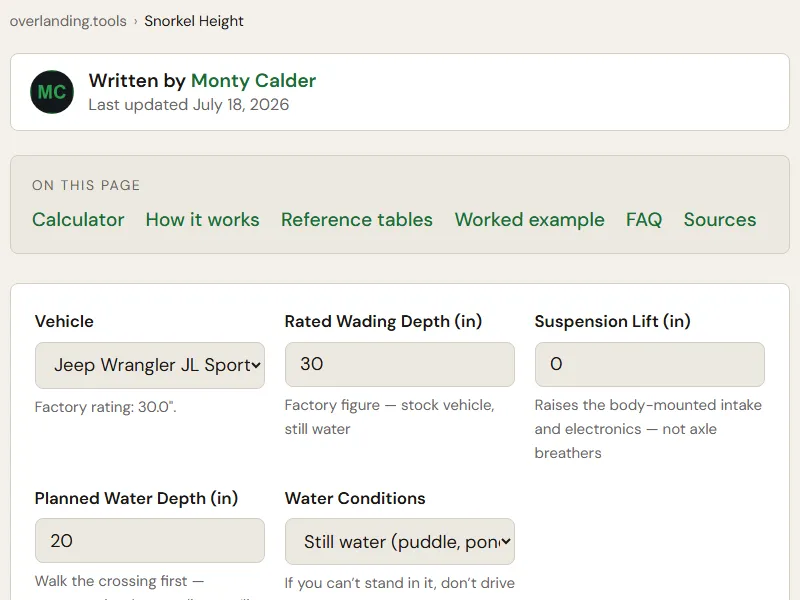
rated limit    = factory wading depth   (suspension lift not credited)
safe depth     = rated limit x 0.80   (20% bow-wave margin)
moving water   = never reads as safe, slow or swift; swift refused outright at 12 in+ (NWS)

verdict: under safe depth, still water Within safe depth - safe to rated Snorkel + prep territory - over rated Too deep - moving water short of the swift refusal gate Moving water caution
Every factory wading rating describes the same test: a stock vehicle, still water, and a slow, steady entry. The number is set by whatever drowns first — usually the air intake or the electronics, both mounted to the body — and it ranges from about 27.6 inches on a Lexus GX 550 to 43.1 inches on a Rivian R1T. Water is incompressible: one good gulp through the intake hydrolocks the engine and bends rods, which is why the intake height governs everything else.
A snorkel does not raise your rated depth. Snorkel makers say so themselves — a snorkel relocates the intake to roof height so a bow wave, a hidden hole, or a splash can't feed water to the engine, but the manufacturer's quoted wading depth doesn't change. What a snorkel buys is insurance at the depths you were already rated for, and — combined with extended breathers and sealed joints — the confidence to use the full rated depth instead of the 80 percent planning line.
The 20 percent bow-wave rule. Enter at a fast walking pace and the vehicle pushes a bow wave ahead of it, dropping the water level in the engine bay; stall mid-stream and that wave collapses back over everything at once. Snorkel installers recommend planning to about 80 percent of your intake or rating height for exactly this reason, so the calculator holds 20 percent in reserve and calls the zone above it snorkel + prep territory.
Breathers are the quiet killer. Axles, gearboxes, and transfer cases vent through small tubes, and a hot differential dropped into cold water pulls a vacuum that sucks water in through any submerged breather. The gear oil turns to milky sludge and the bearings die weeks later. A suspension lift does not move axle breathers an inch — extension kits that route them up high are the mandatory companion mod to any snorkel.
Moving water changes everything. The National Weather Service's flood-safety numbers are blunt: 6 inches of fast-moving water can knock over an adult, 12 inches can carry away most cars, and 2 feet will float SUVs and trucks. That is why the calculator refuses swift or flooded crossings of 12 inches or more regardless of your hardware, and why the oldest rule in overlanding still stands — walk it before you drive it.
These are planning figures. Toyota publishes no US wading figure for the 4Runner, Tacoma, or Land Cruiser, and Ford publishes none for the standard F-150 — the flagged estimates are community planning numbers, not specs. Ratings also assume factory seals in factory condition. The presets get you to the right conversation; your owner's manual and a walk through the actual water finish it. The verdict carries a small tolerance so a metric round-trip can never flip it over a rounding error.