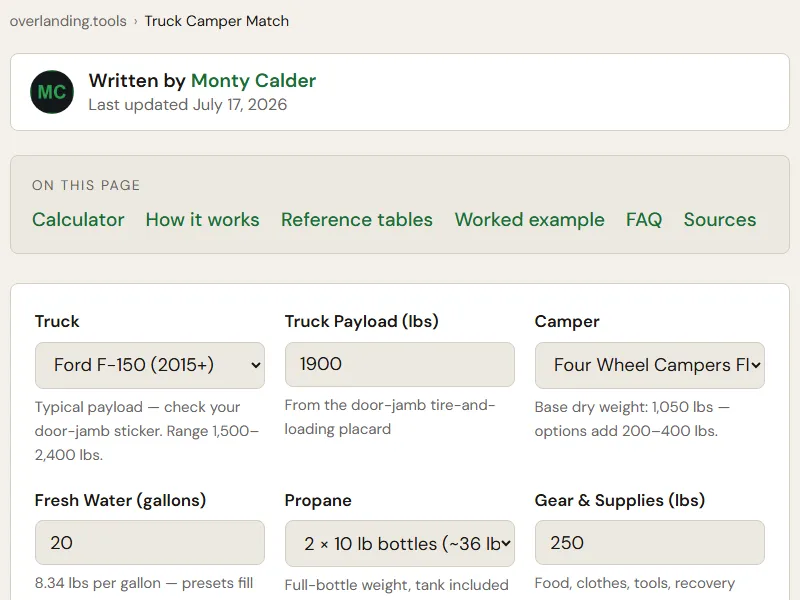
camper wet weight = dry weight + water gallons x 8.34 lbs + full propane bottles
total load        = wet weight + gear + occupants x 165 lbs
payload used      = total load / door-sticker payload

verdict: under 90% Within payload - 90-100% Near the limit - over 100% Over payload
A truck camper lives or dies on one number: the payload figure on your driver's door jamb. Not bed length, not towing capacity, not what the salesperson said — the tire-and-loading placard that reads "the combined weight of occupants and cargo should never exceed XXX lbs." That number is GVWR minus your truck's actual curb weight as built, and every person, accessory, and pound of gear in the truck counts against it, camper included.
Dry weight is a marketing number. The brochure dry weight is the base camper with empty tanks and no options. Real campers leave dealer lots 200–400 lbs heavier once air conditioners, awnings, generators, and solar are bolted on — and that is before you add water at 8.34 lbs per gallon, full propane bottles, food, and gear. A "1,200 lb" pop-up is routinely a 1,900 lb load by the time it rolls onto a trail.
Why the 90 percent guideline. The calculator flags anything between 90 and 100 percent of payload as "near the limit" because static math flatters the load: washboard, potholes, and off-camber trails multiply the effective weight your springs, brakes, and tires must handle. Running at the sticker limit on pavement means running over it off-road. Leaving a 10 percent margin is the difference between a truck that carries a camper and one that merely survives it.
Air bags and helper springs do not add payload. They level the truck and control sway, which makes a loaded truck nicer to drive — but payload is set by GVWR, axle ratings, tires, and frame, none of which change with air bags. A level truck over its GVWR is still over its GVWR.
Center of gravity matters as much as weight. Camper manufacturers publish a center-of-gravity point, and it needs to land ahead of your rear axle centerline — most truck beds carry a marked COG zone. Tall hard-side campers also raise the combined center of gravity, which is why the same trail feels different with 3,000 lbs riding high in the bed.
These are planning figures. Truck payloads span hundreds of pounds within one model depending on cab, bed, engine, and options, and camper weights vary by model year and build sheet. The presets get you to the right conversation; your door-jamb sticker and the camper's own weight sticker finish it. The verdict also carries a few pounds of tolerance so a metric round-trip can never flip it over a rounding error.