Approach angle  = arctan(ground clearance ÷ front overhang)
Departure angle = arctan(ground clearance ÷ rear overhang)
Breakover angle = 2 × arctan(ground clearance ÷ (wheelbase ÷ 2))
A lift adds to clearance; bigger tires add half the diameter increase (× 0.97 loaded).
Three numbers define how a vehicle handles the terrain before you even turn a wheel: approach angle, departure angle, and breakover angle. Together they are standardized under SAE J689, the industry-accepted measurement method that automakers use to publish official specifications. Understanding what each number means, and how to improve it, is the foundation of serious vehicle preparation.
Approach angle is the maximum incline a vehicle can ascend without the front bumper or fascia contacting the ground. It is measured as the angle between the ground plane and a line drawn from the front tire contact patch to the lowest forward-most point of the vehicle. A stock Toyota Tacoma TRD Pro has a factory approach angle around 32°. A built Jeep Wrangler Rubicon measures 44°. That 12-degree difference is the gap between "scrapes on modest ledges" and "climbs almost anything."
For most overlanders, approach angle matters more than departure angle. Front obstacles like boulder lips, creek banks, and embedded rocks are encountered head-on. Your front bumper is almost always the first piece of hardware that threatens to touch terrain. This is why high-clearance tube bumpers are one of the highest-return modifications on any build: eliminating or replacing the stock plastic fascia can add 8–12 degrees of approach angle instantly, with no suspension work required.
Departure angle follows the same geometry at the rear: the angle from rear tire contact to the lowest rearmost point. Rear bumpers with integrated tire carriers, trailer hitches, and low-hanging exhaust tips are common departure angle killers. A rear bumper swap can recover 5–10 degrees on vehicles with poor factory departure numbers.
Breakover angle (sometimes called ramp breakover angle) is the angle of the sharpest ridge or peak a vehicle can straddle without the belly catching. It is calculated as twice the arctangent of ground clearance divided by half the wheelbase. This means short wheelbase and high clearance both improve it multiplicatively. Extended crew cab pickups with 144-inch wheelbases suffer dramatically here: a modest rock hump that a short-wheelbase Bronco clears easily will high-center the long pickup every time.
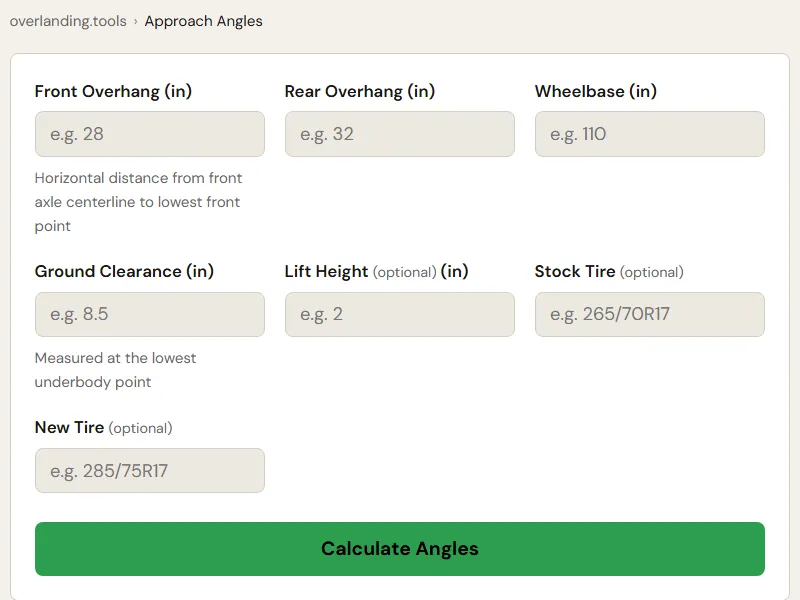
Measuring your overhangs: Front overhang is the horizontal distance from the front axle centerline to the farthest-forward point of the vehicle, typically the bumper, brush guard, or tow hook. Do not measure to the tire. Rear overhang is the same measurement at the back, to the farthest-rearward point. Both measurements should be taken with the vehicle on level ground and loaded to typical trail weight. Ground clearance is measured at the absolute lowest underbody point, usually the differential pumpkin, transfer case, or exhaust. Measure clearance as the lowest point anywhere under the overhang and overhang to the farthest forward/rearward point, and the computed angle can only understate, never overstate, any single component's true angle: every point on the vehicle sits at or above the entered clearance and at or within the entered overhang, so its own angle is at least the calculator's number. Mixing a low point measured mid-vehicle (like the differential) with a shorter overhang measured to a different, closer point (like the tire) breaks that guarantee. This guarantee also applies to your as-measured stock geometry only, with the lift field left blank: a planned lift adds directly to the shared clearance value in this calculator, but a real suspension lift raises the body and bumpers, not axle-mounted components like the differential, so lift-adjusted results are estimates, not a guaranteed lower bound.
Practical thresholds: A 35° approach angle is the commonly cited threshold for moderate off-road capability: desert two-track, light forest roads, basic rock trails. Above 40° puts you into serious rock crawling territory. Below 25° is fine for graded dirt roads and maintained trails but will limit you on technical terrain. Improving from 28° to 36° with a bumper swap and 2-inch lift is a realistic weekend build that transforms the experience.
Use the mod comparison fields in this calculator to quantify the improvement from your planned lift and tire upgrade before spending money. A 3-inch lift combined with going from 265/70R17 to 285/75R17 tires adds roughly 4 inches of ground clearance (the lift plus about an inch of extra tire radius). That's enough to move approach angle from about 17° to 24° on a rig with 8.5 inches of clearance and a 28-inch front overhang, and improve breakover from about 18° to 26° on a 110-inch wheelbase. It's a real, stackable gain, and it compounds further with a high-clearance bumper.