net added      = bumper + winch + accessories - OEM bumper removed
front-axle add = net added x 1.25   (front-overhang leverage)
new front load = front axle at curb + front-axle add

axle verdict: under 90% of GAWR Within front axle rating - 90 to 100% Near the front axle limit - over GAWR Over the front axle rating
springs (raw added weight, +/-5 lb tolerance): under 100 lbs Stock springs - 100 to 220 Medium-duty coils - 220+ Heavy-duty coils
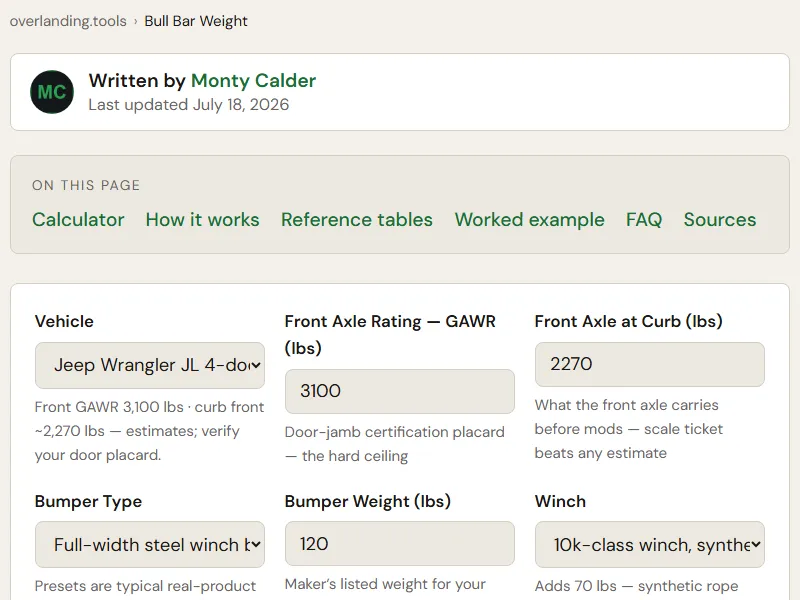
Every axle has a hard ceiling: the Gross Axle Weight Rating stamped on your door-jamb certification placard. Manufacturer owner's manuals are blunt about it — do not exceed either the front or rear GAWR, or steering, braking, and tire loading all degrade. The catch for overlanders is that brochures almost never print the front figure, and factory front axles carry less spare capacity than people assume: on most midsize trucks and 4x4s, the front axle has just 400 to 900 pounds of headroom at curb before you bolt on a single accessory.
Weight up front counts extra. A bumper and winch hang ahead of the front axle, so simple lever physics applies: taking moments about the rear axle, a weight W mounted a distance a ahead of the front axle (wheelbase L) loads that axle by W × (1 + a/L) — and unloads the rear axle by the difference. Across the vehicles in this set that factor runs from about 1.17 on a long-wheelbase pickup to 1.30 on a short Wrangler, so the calculator uses a disclosed 1.25: bolt on a net 145 pounds and the front axle sees about 181.
Springs are a separate question from safety. Suspension makers rate front coils by constant added load, not by axle utilization. Old Man Emu's bands are typical: light coils to about 110 pounds of permanent accessories, medium to 220, heavy beyond that — and ARB's own guidance pairs "full-width steel bumper with a winch" with heavy coils. The calculator steps up to medium a touch early, at 100 pounds, for a conservative margin. A steel bull bar plus a 10k winch is roughly 160 to 210 pounds of constant load, which is squarely heavier-coil territory even on a truck whose axle rating shrugs it off. Removable gear doesn't count; the winch you never take off does.
The 90 percent planning line is ours, not the factory's. A static estimate can't see occupants, a full tank, chassis-mounted extras you forgot, or the dynamic loads of an off-camber descent. The calculator flags anything past 90 percent of front GAWR as near the limit so you make the call with margin in hand, and anything past the rating itself as a hard no. That buffer is our engineering recommendation — the GAWR ceiling is the manufacturer's.
Payload doesn't care about leverage. The leverage factor applies only to the axle check — your payload budget loses exactly the raw net weight you added. A typical steel-bumper-and-winch package eats 145 to 185 pounds of payload, about one adult passenger, before you load a single duffel. The OEM bumper you remove claws some of it back, which is why the calculator credits it.
These are planning figures. Only five vehicles in the preset list have manufacturer-published front curb splits — the rest are curb weight times a corroborated front weight distribution, flagged as estimates. Front GAWR itself varies by trim and package on several models. The presets get you to the right conversation; your own door placard and a CAT-scale ticket finish it. The verdict carries a small tolerance so a metric round-trip can never flip it over a rounding error.