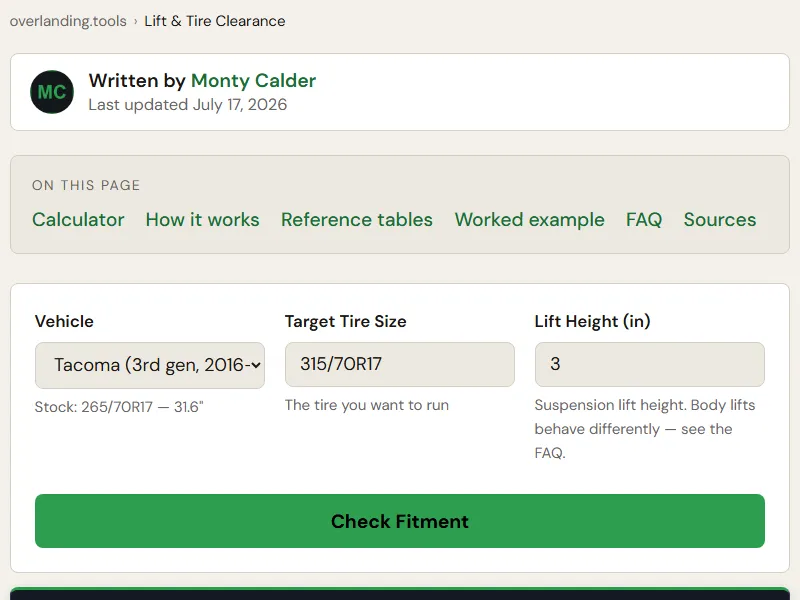
Preset vehicles: verdict = target diameter vs charted max-clean / max-trim tire,
linearly interpolated at your lift height (see the chart below).

Unlisted vehicles (rule of thumb):
max clean tire   = stock diameter + 1.0" + 1.0" x lift height
max with trimming = max clean + 0.75"
minimum lift      = max(0, target - stock - 1.0")
with trimming     = max(0, target - stock - 1.75")
Suspension lift and tire clearance are related, but they are not the same measurement, and treating them as interchangeable is the most common way overlanders end up with a rubbing tire. A lift raises the vehicle vertically, pushing the fender opening away from the top of the tire at ride height. But the tire contacts the fender liner, frame, or control arms at full suspension compression and at full steering lock — both of which are lateral and diagonal movements a taller lift barely touches. That is why the calculator asks for your specific vehicle: the charted numbers already account for where each platform actually rubs, not just how tall the lift is.
Clean vs. trim. "Clean" means the tire cycles through its full range of suspension travel and steering lock without touching anything — no cutting, no rubbing. "With trimming" is not one uniform amount of work: cutting back the plastic fender liner or deleting the factory mud flaps is simple, reversible bodywork most owners handle in an afternoon. A cab-mount or body-mount chop, called out in the notes for a handful of platforms, is a different scope entirely — cutting and re-welding a structural bracket behind the front wheel — and that is fabrication on a load-bearing mount, not trim. Treat any build that needs a cab-mount or body-mount chop as a job for a qualified fabricator, and check a vehicle's notes in the reference table before assuming "with trimming" only means liner and mud flaps.
Width, offset, and backspacing. The fitment chart assumes a typical aftermarket wheel offset for each platform. A wider tire, or a wheel with less backspacing (more negative offset), pushes the tread outward — away from frame rails and control arms, but closer to the fender edge at full lock. That trade-off is why two builds running the "same" tire size can have very different rub points depending on wheel choice.
The 10 percent regear rule. Once your new tire diameter is roughly 10 percent larger than stock, the effective gearing drops enough to be felt: less low-end torque, more throttle to maintain speed, and a shorter-legged transmission hunting for gears. If your build crosses that line, run the numbers through the Gear Ratio calculator to find the ratio that restores your stock RPM at speed.
These are estimates, not guarantees. The preset fitment figures are curated from platform-specific fitment guides and long-running owner-forum consensus, and they carry roughly ±0.5 inch of build-to-build variance from wheel choice, alignment, ride height, and trim level. Always verify clearance yourself at full suspension compression and full steering lock before trusting a size on the trail.
Why the verdict has a tolerance band. The calculator treats a target diameter within about 0.05 inch of a chart boundary as a match rather than a fail. Without that small tolerance, a metric-to-inch round trip (76 mm converting back to 2.99 rather than exactly 3.0 inches) could flip a tire from "fits" to "won't fit" over a rounding error that has nothing to do with actual clearance.