Target-RPM ratio = target RPM × (new tire diameter × 0.97) ÷ (highway MPH × top-gear ratio × 336)
Stock-feel restoration ratio = (new tire diameter ÷ old tire diameter) × current axle ratio
Achievable highway RPM = MPH × nearest listed axle ratio × top-gear ratio × 336 ÷ (new tire diameter × 0.97)
Crawl ratio = 1st-gear ratio × transfer-case low ratio × recommended axle ratio
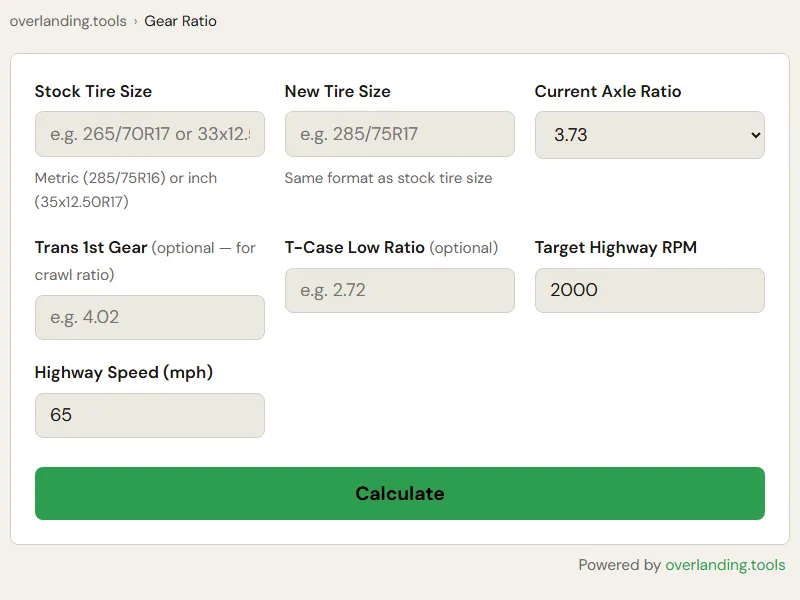
When you enter a target RPM, highway speed, and top-gear ratio, the Target-RPM ratio answers that cruising goal for the new tire diameter. The calculator then shows the mathematically ideal ratio and the nearest listed standard ratio, along with the highway RPM that nearest ratio can actually achieve.
The stock-feel restoration ratio is a separate comparison: (New Tire Diameter / Old Tire Diameter) × Current Axle Ratio. It estimates the ratio that offsets the tire-size change relative to the old setup; it does not replace the target-RPM calculation.
RPM at a given speed uses the rolling tire diameter (nominal diameter × 0.97): RPM = (MPH × Gear Ratio × Overdrive × 336) / Rolling Tire Diameter. The constant 336 converts miles per hour to revolutions per minute through wheel circumference.
Crawl ratio (when optional inputs are provided) is: Trans 1st × T-Case Low × Recommended Axle Ratio. It uses the recommended ratio rather than the one currently in the vehicle, so the figure is the low-speed control you would have after regearing — the stat card names the ratio it assumes.
The verdict grades the gap between your target and what that nearest listed ratio actually achieves: 5% or less reads as a pass, above 5% through 10% as a warning, and above 10% as a fail. It grades the same one-decimal percentage it prints on the card, so the figure you read and the color it carries always agree. Because ratios are only manufactured in fixed steps, a target outside the listed range is answered with the closest ratio in that list — the percentage is what tells you how far that compromise lands from what you asked for.
Standard gear ratios are manufactured in common increments (3.21, 3.55, 3.73, 4.10, 4.56, 4.88, 5.13, 5.38). Before purchase, verify that the nearest listed ratio is manufactured and fits both vehicle axles; availability and fitment are vehicle-specific.