Per-tire load = axle load ÷ 2
Table comparison load = per-tire load × 1.10 for unadjusted passenger-tire capacities in light-truck use; otherwise per-tire load
Load floor = lowest listed pressure whose source capacity supports the comparison load
Supported range = overlap(load floor, your terrain guidance interval, each axle's verified cold-pavement ceiling)
Maximum off-road speed must be below 15 mph
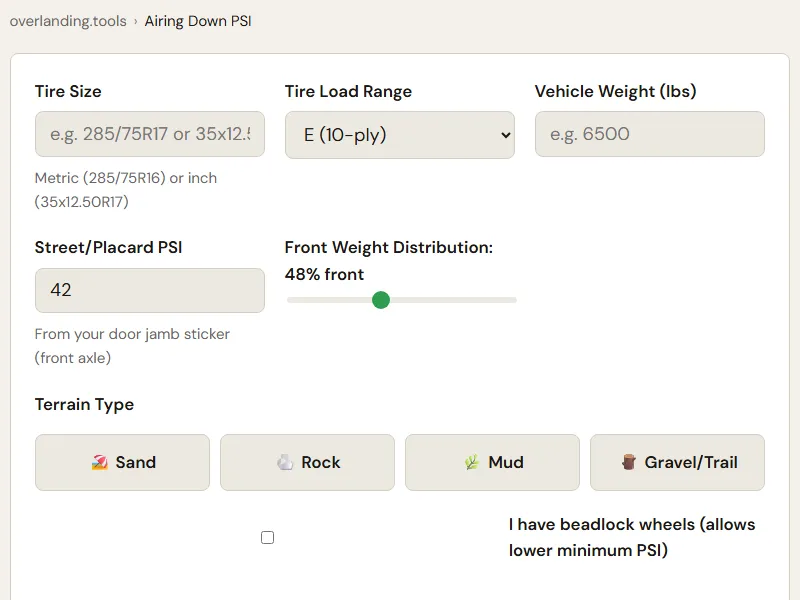
Manufacturer load/inflation rows establish tire capacity only at the pressures they list. For each axle, the calculator divides the axle load by two and selects the lowest listed pressure whose source capacity supports the application-adjusted comparison load. Passenger-tire capacities in light-truck applications require a 1.10 adjustment: the calculator compares raw capacities against per-tire load multiplied by 1.10. If the source explicitly already divided capacities by 1.10, it does not adjust them again. LT tires and passenger-car applications use the unadjusted per-tire load. No comparison values are rounded. It preserves the authored rows, rounds up to the next supporting row, and never interpolates or fills gaps.
The selected load floor is intersected with your sourced terrain guidance interval and each axle's verified cold-pavement ceiling. The terrain interval is user-supplied guidance, not manufacturer load evidence. There is no universal pressure: tire construction, load, wheel fitment, terrain, temperature, and driving inputs all matter.
Measured axle totals assume equal left/right loading; an estimated vehicle-weight split is lower-confidence and should be verified on a scale. Corner-scale data can identify the heavier wheel-position load when available. This calculator assumes exactly two tires on each axle and does not support dual-wheel configurations.
This calculator is limited to off-road operation with an expected maximum speed strictly below 15 mph. Beadlocks are wheel-retention context, not load evidence, and they do not waive that envelope. A placard is usable only for matching OE fitment; replacement tires need verified adjusted cold-pavement values. Treat every result as an evidence-bounded starting range, watch for tire or wheel warnings in the field, and reinflate to the verified front and rear road pressures before pavement.