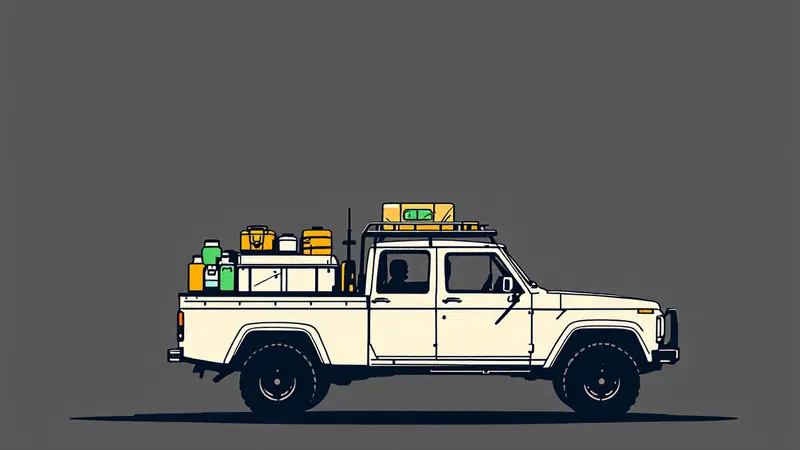
A fully kitted midsize truck often lands right at or over its GVWR: our example build adds about 1,160 lb of gear and people against roughly 1,100 lb of payload. Half-ton trucks and wagons carry more headroom, but not by much once you add a camper or roof rack.
Here's an uncomfortable truth: a large share of fully kitted overland rigs are driving around over their gross vehicle weight rating (GVWR), and most owners have no idea. Payload disappears faster than people expect: a rooftop tent here, a drawer system there, full water and fuel, two adults and a dog, and a midsize truck's thousand-ish pounds of capacity is gone before you've packed food. Being over GVWR strains brakes, steering, and suspension, can void warranties, and is a liability after a crash. Let's see where the weight actually goes.
The math (and the fuel trap)
Payload = GVWR − curb weight. Your GVWR and payload (the combined occupants-and-cargo figure) are both on the driver's door-jamb sticker; curb weight usually isn't, so read payload directly or subtract it from GVWR. The catch most people miss: published curb weight already includes a full tank of fuel and all fluids. So when you tally what you're adding, don't add the fuel again: it's already in curb. (Extra fuel in jerry cans beyond the main tank does count.) Everything else (passengers, gear, accessories) eats into payload, and if you're towing, tongue weight eats into that same payload budget.
Build 1: Midsize truck (Tacoma-class)
Numbers are representative; check your own door jamb. GVWR ~5,600 lb, curb ~4,500 lb → payload ~1,100 lb.
| Item | Weight |
|---|---|
| Two adults | 340 lb |
| Rooftop tent + rack | 200 lb |
| Bed drawer system | 150 lb |
| Fridge (loaded) + slide | 90 lb |
| Water, 6 gal | 50 lb |
| Steel front bumper + winch | 180 lb |
| Recovery gear, tools, food | 150 lb |
| Total added | 1,160 lb |
That's over the ~1,100 lb payload before you've filled jerry cans, the classic midsize overload. This rig needs a ruthless gear diet or a payload-focused build (lighter tent, skip the steel bumper).
Build 2: Half-ton truck (F-150-class)
GVWR ~7,050 lb, curb ~5,000 lb → payload ~2,050 lb. The same kit fits with room to spare:
| Item | Weight |
|---|---|
| Two adults + dog | 400 lb |
| Bed camper / wedge | 700 lb |
| Drawers, fridge, water (12 gal) | 340 lb |
| Bumper + winch | 180 lb |
| Recovery, tools, food, extra fuel (5 gal) | 230 lb |
| Total added | 1,850 lb |
About 200 lb of headroom left. Comfortable, but a heavier camper would close that gap fast. Half-tons feel roomy until you add a slide-in.
Build 3: Body-on-frame wagon (4Runner/LX-class)
Wagons carry their gear inside and high, so the watch-out is as much the roof and center of gravity as the scale. GVWR ~6,300 lb, curb ~5,000 lb → payload ~1,300 lb.
| Item | Weight |
|---|---|
| Two adults | 340 lb |
| Drawer/sleep platform | 130 lb |
| Fridge + dual battery | 120 lb |
| Roof rack + RTT | 180 lb |
| Water, recovery, tools, food | 230 lb |
| Total added | 1,000 lb |
Under payload. But that roof tent plus rack is ~180 lb up high. Check it against your roof's dynamic rating and your rig's center of gravity, not just total payload; our roof load ratings guide explains the static-vs-dynamic split. (Our Roof Rack Weight calculator covers that limit.)
Takeaways
- Passengers are payload. Two adults is ~340 lb off the top before any gear.
- Don't double-count fuel. The main tank is already in curb weight.
- Steel armor adds up fast. A bumper-and-winch combo is ~180 lb in one spot.
- GAWR matters too. You can be under GVWR but over a single axle's rating if the load is unbalanced.
- Weigh it. A CAT scale ticket is the only number that isn't a guess.
Bottom line
Tally your build in the Payload Calculator before the next trip. If you're a midsize owner, assume you're closer to the limit than you think, and remember the fuel is already counted. Then go confirm it on a scale.