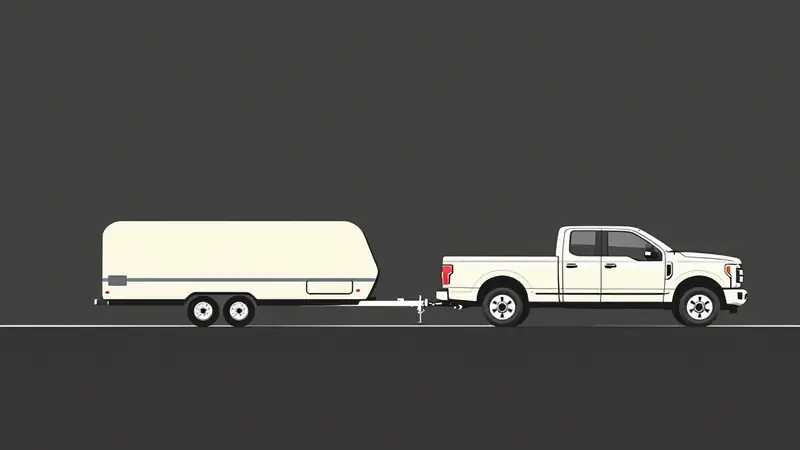
Keep tongue weight between 10 and 15 percent of gross trailer weight, aiming for about 13 percent. Also keep the trailer's total weight under roughly half your tow vehicle's curb weight, or you may need a weight distribution hitch even with tongue weight correct.
Trailer sway looks like bad luck. You are at 65 on the interstate, a semi passes, and the trailer starts a slow wag that builds instead of settling out. Almost every time, that moment was decided back in the driveway. The culprit is tongue weight: how much of the trailer's weight presses down on the hitch ball instead of riding over the trailer's own axles. Keep that number inside a fairly narrow window and the trailer tracks behind you like it is on rails. Miss it low and you have built a pendulum.
What tongue weight actually is
Tongue weight is the static downward force the coupler puts on the ball when the trailer sits level. The important thing is that it is not a fixed property of your trailer. It is a property of how you loaded it this morning. The trailer's axles act as a fulcrum: anything you put ahead of them presses the tongue down, and anything behind them levers the tongue up. Slide a full water tank, a generator, or a pair of fuel cans a few feet either direction and you have changed the number.
The window, in real numbers
Take a common setup: a 5,200 lb dry trailer with 800 lb of gear and water in it. That is a gross trailer weight of 6,000 lb, and every percentage below is measured against it. The target window runs from 10 to 15 percent, which CURT Manufacturing and every major tow guide agree on.
| Tongue weight | % of 6,000 lb GTW | What happens |
|---|---|---|
| 420 lbs | 7.0% | Sway starts on its own |
| 540 lbs | 9.0% | Still too light to settle |
| 600 lbs | 10.0% | Bottom of the window |
| 780 lbs | 13.0% | Where you want to live |
| 900 lbs | 15.0% | Top of the window |
| 1,020 lbs | 17.0% | Hitch and rear axle overloaded |
The window is narrower than it looks. Between the 600 lb floor and the 900 lb ceiling there is only 300 lb of room, and a single misplaced item eats a third of that.
Too little is the one that hurts you
A trailer with too little tongue weight has its center of gravity too close to the axles, so barely any weight presses down on the tongue. Give it a shove from a passing truck or a crosswind and there is too little holding the nose in line, so the trailer yaws, overshoots, and yaws back harder. Each cycle feeds the next. Here is how easy it is to fall out of the window: move a 200 lb generator from 2 ft behind the axles to 6 ft ahead of them on a trailer with 15 ft between coupler and axles, and you add about 107 lb of tongue weight. Do it in reverse and a legal 600 lb tongue, right at 10.0 percent, drops to roughly 493 lb, or 8.2 percent. One item, moved once, and the trailer is now unstable.
Too much is not safe either
Push past 15 percent and the problems move to the tow vehicle. That force lands behind the rear axle, which levers weight off the front wheels. Steering goes light, the headlights point at the trees, and braking suffers exactly when you need it. It also eats your payload, since every pound on the ball is a pound out of the truck's cargo rating. That is a separate budget worth checking against our payload breakdown before you load up.
The ratio nobody checks
Tongue percentage can be perfect and the rig still unstable, because the second number matters just as much: trailer weight against tow vehicle weight. Our calculator flags sway risk once gross trailer weight passes 50 percent of the tow vehicle's curb weight. That 6,000 lb trailer behind a 5,200 lb half-ton works out to 115 percent, more than double the mark. A heavy trailer behind a light vehicle sways because the tail really can wag the dog, and correct tongue percentage does not repeal that. The same calculator will tell you a weight distribution hitch is required here.
Measuring it in your driveway
You do not need a shop. A tongue weight scale is the easy answer, but a bathroom scale works if you build a lever. Rest a sturdy board across two pipes about 3 feet apart, one pipe on the scale and the other on a brick of the same height, then set the coupler on the board 2 feet from the scale and 1 foot from the brick and multiply the reading by 3. Under about 300 lb you can skip the lever and set the tongue on the scale directly. Do it loaded the way you actually travel, with water in the tank and gear in its real spots, because measuring an empty trailer tells you nothing about the one you tow.
Bottom line
Sway is a loading problem with a loading fix. Weigh the tongue loaded, land it between 10 and 15 percent of gross trailer weight, keep the heavy items ahead of the axles, and check the trailer against your tow vehicle's weight too. Run your numbers through the Towing Capacity Calculator before the trip, not after the first pass on the interstate.