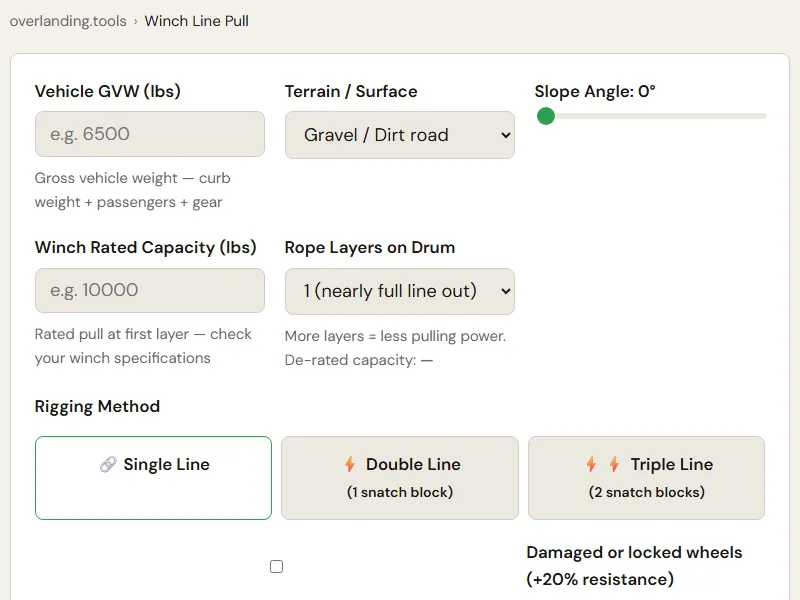
When a vehicle gets stuck, the winch must overcome two primary forces: rolling resistance and grade resistance. Rolling resistance is determined by the terrain — the U.S. Army FM 20-22 field manual documents ground resistance coefficients ranging from about 4% on hard pavement and ~18% in soft sand up to nearly 100% for a vehicle bogged to the chassis in soft mud. Multiply your vehicle's gross weight by that coefficient and you have the baseline pull force required to move the vehicle on flat ground.
The 1.25 safety factor built into this calculator reflects SAE recovery standards and accounts for dynamic loading during recovery. A winch that is rated exactly at your required pull will be overloaded during the initial break-free surge — that momentary spike can exceed steady-state pull by 20–30%. The 1.25× multiplier ensures your winch has adequate headroom for that dynamic event.
Snatch blocks create mechanical advantage by splitting the load across both legs of the rope. A single snatch block in double-line configuration theoretically doubles pull force — but rope angle and pulley friction reduce real-world efficiency to roughly 1.8×. Two snatch blocks (triple-line) yield approximately 2.4× effective pull. However, there is a critical trade-off: the anchor point in double-line rigging experiences nearly twice the winch load, because both rope legs pull against the anchor. A tree saver strap rated for 8,000 lbs may fail when your 10,000-lb winch is rigged double-line to it.
Drum layer de-rating is one of the most overlooked factors in winch selection. As rope accumulates on the drum, the effective drum radius increases, which reduces torque advantage at the drum face. The result is approximately a 10–13% reduction in rated pull per additional layer. A winch rated at 10,000 lbs on the first layer delivers roughly 8,700 lbs on layer 2, 7,600 lbs on layer 3, and 6,600 lbs on layer 4. This is why the standard industry recommendation is to spool out most of the rope before winching — keep fewer layers on the drum for maximum pulling power.
The industry standard rating for winches is measured with a single layer of wire rope on the drum, at zero incline, on a hard surface. This means a 10,000-lb rated winch will rarely deliver 10,000 lbs in a real recovery. Understanding drum layers, terrain coefficients, and rigging multipliers together gives you a realistic picture of what your winch can actually do when you need it most.
Synthetic rope has become the preferred choice for overlanding. Unlike steel cable, synthetic rope does not store significant kinetic energy when under load — if it breaks, it falls to the ground rather than snapping back with potentially lethal force. It is also lighter, easier to handle with bare hands, and floats in water. Steel cable has the edge in abrasion resistance against rocks and sharp edges, but for general trail recovery, synthetic rope's safety profile is superior. Inspect either type before every use: look for fraying, kinks, or discoloration that suggests heat damage or UV degradation.