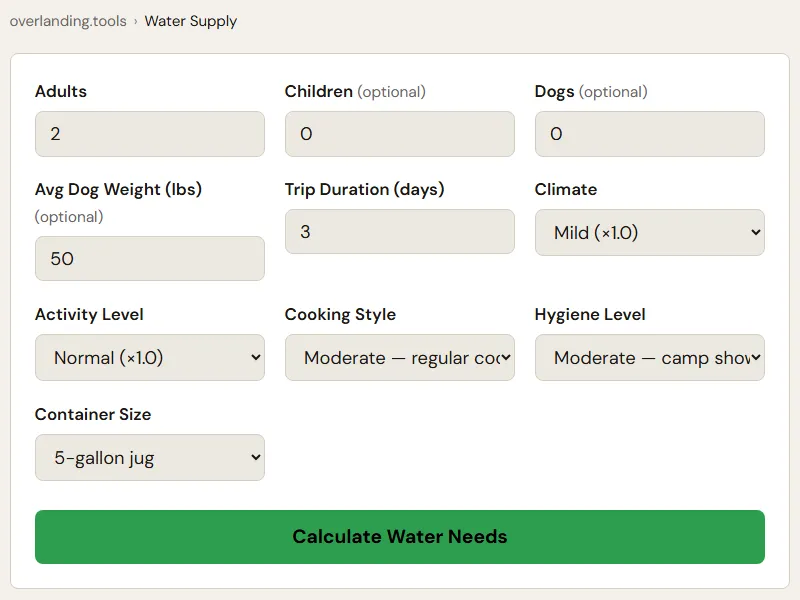
Water is the most critical supply item for desert overlanding — more important than food, more unforgiving than fuel. Unlike running low on gas, severe dehydration can incapacitate you within hours in high heat, long before rescue is possible. The CDC establishes 1 gallon per person per day as the emergency minimum for survival. Overlanding consensus, however, settles on 2 gallons per person per day as the realistic planning baseline when you account for cooking, cleaning, and basic camp hygiene. In hot desert conditions or with active hiking, that figure can climb to 3 gallons or more.
Several factors drive your actual water consumption well above the baseline. Climate is the most significant variable: a hot, dry desert environment increases fluid loss through perspiration and respiration dramatically compared to a cool mountain trip. Activity level compounds this effect — a day of technical hiking burns through water far faster than a relaxed camp day. Cooking style matters more than most people realize: boiling pasta, making coffee, and washing dishes can consume nearly as much water as drinking, depending on your camp routine. Hygiene practices round out the equation — wipes-only hygiene uses minimal water, while a daily solar shower adds a meaningful volume to your daily total.
Dog hydration is consistently underestimated on overlanding trips. Dogs require approximately 1 ounce of water per pound of body weight per day under normal conditions. A 60-pound dog needs about half a gallon daily, and in heat with exercise that figure can double. Dogs cannot tell you when they are dehydrating — watch for dry gums, sunken eyes, lethargy, and loss of skin elasticity (skin tenting). Build dog water into your calculation the same way you would for any member of your crew.
Container selection is both a practical and logistical decision. Rigid 5- and 7-gallon jugs like the Reliance Aqua-Tainer are the workhorses of overlanding water storage: HDPE construction, BPA-free, UV-stabilized, with a built-in spigot for controlled dispensing. They stack efficiently and are easy to refill. Military-style jerry cans (like the Scepter water can) offer a more compact footprint and are extremely durable, though they lack a spigot. Collapsible bladders and soft-sided containers save space when empty but are more prone to puncture and harder to thoroughly clean on multi-day trips. For serious desert travel, 5- and 7-gallon rigid jugs provide the best balance of capacity, durability, and daily usability.
Water weight is a payload consideration that surprises newer overlanders. Water weighs 8.34 lbs per gallon — one of the heaviest consumables you carry. A 7-day trip for 2 adults at moderate climate and settings requires roughly 80–100 lbs of water alone. That payload comes directly out of your vehicle's capacity budget alongside gear, recovery equipment, food, and passengers. If your vehicle is near payload limits, water planning is not just a comfort issue — it's a safety and mechanical one.
Where water sources exist on your route, filtration can supplement your carry capacity. Gravity filters like the LifeStraw Mission and Sawyer Squeeze are effective at removing biological contaminants from streams and springs. However, they do not address chemical contamination, heavy metals, or all viral threats. In the American Southwest, springs and streams can be seasonal, GPS-listed sources sometimes run dry in drought years, and historical sources may carry agricultural runoff. Always verify sources with current trip reports before relying on them, and carry a non-negotiable emergency supply regardless of filtration plans. The CDC's emergency water guidelines serve as the minimum floor — build your planning well above that floor.