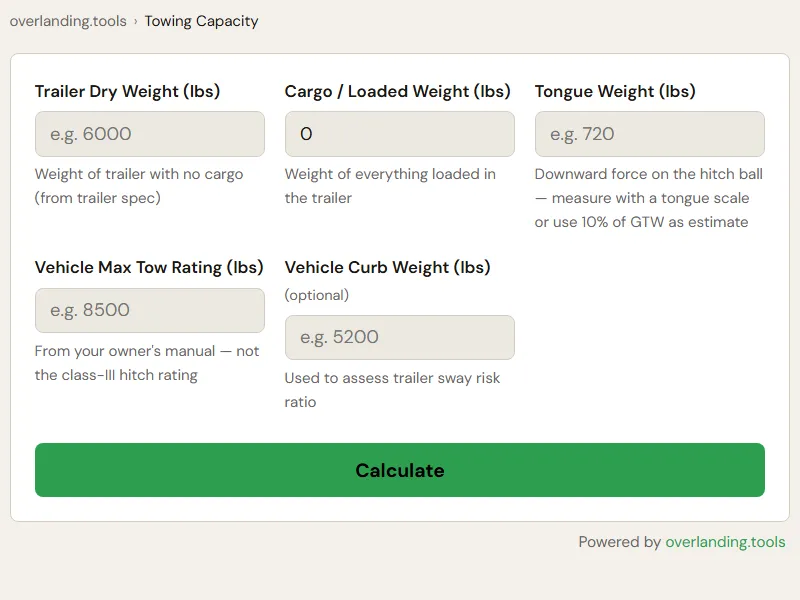
Gross Trailer Weight (GTW) is the total weight of your trailer when fully loaded for travel — the trailer's dry weight plus every item you've packed inside. This is the number that must stay below your vehicle's maximum tow rating. Many overlanders confuse dry trailer weight with GTW, then add 600 lbs of camping gear, tools, and water tanks without recalculating. The result is a setup that exceeds the tow rating without the driver being aware of it.
Tongue weight — the downward force the trailer's coupler places on the hitch ball — must fall within 10–15% of GTW for stable towing. Below 10%, the trailer's rear is too heavy relative to its front, causing the trailer to sway side-to-side in a fishtailing motion that escalates with speed and crosswinds. Above 15%, the tongue overloads the rear axle of the tow vehicle, reducing front-axle weight and with it, steering response and braking effectiveness. The ideal 10–15% range is not arbitrary — it is the empirically validated zone where trailer tracking is stable and vehicle handling is preserved.
The 50% Sway Threshold
When a trailer's GTW exceeds 50% of the tow vehicle's curb weight, sway risk increases significantly. A 4,000-lb trailer behind a 5,000-lb vehicle is at 80% of curb weight — a setup that demands conservative speed, a weight distribution hitch, and ideally an integrated sway control system. Many tow vehicle manufacturers set their tow rating thresholds precisely at this 50% ratio for base configurations. Exceeding it does not mean the vehicle cannot physically pull the load — it means the dynamic stability envelope shrinks considerably.
When You Need a Weight Distribution Hitch
A weight distribution hitch (WDH) uses spring bars to distribute tongue weight across all four wheels of the tow vehicle, restoring front-axle weight that is lost when tongue weight loads the rear. WDHs are generally required for GTW over 5,000 lbs with tongue weight over 400 lbs, though many manufacturers set lower thresholds. They are not optional for these setups — towing without a WDH when one is required can cause trailer sway and loss of steering control at highway speeds.
GVWR vs GCWR
Your vehicle has both a GVWR (Gross Vehicle Weight Rating — the maximum weight of the loaded tow vehicle itself) and a GCWR (Gross Combined Weight Rating — the maximum combined weight of the tow vehicle and trailer). Your tow rating is effectively GCWR minus the tow vehicle's curb weight. All three limits apply simultaneously; you must stay within all of them, plus respect payload limits for tongue weight. Understanding these distinctions is the foundation of legal and safe towing.