Swapping to a larger tire is one of the most common modifications overlanders make — but the downstream effects go well beyond aesthetics. Before you buy, it pays to understand exactly what changes when you upsize.
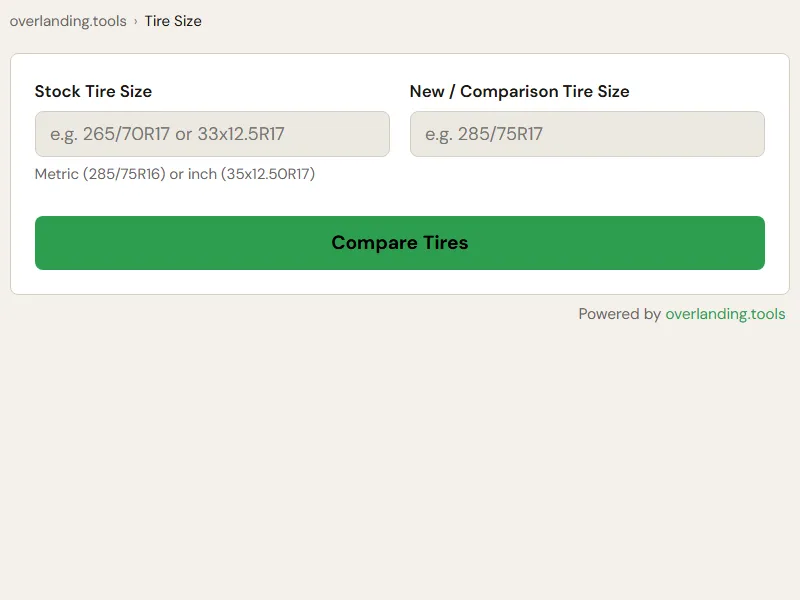
Diameter and ground clearance. Every extra inch of tire diameter adds half an inch of ground clearance (split between top and bottom of the wheel well). A move from 265/70R17 (31.6") to 285/75R17 (33.8") gains roughly 1.1" of clearance — meaningful on rocky terrain. This calculator shows you the exact diameter difference for any two sizes.
Speedometer and odometer error. Your factory speedometer is calibrated for a specific rolling circumference. Larger tires cover more ground per revolution, so the speedo reads low. The formula is straightforward: (new diameter − stock diameter) / stock diameter × 100. A +7% error means your speedo shows 60 mph when you are actually doing 64 mph. This also affects odometer mileage readings and any distance-based maintenance intervals.
Gear ratio and powertrain load. Taller tires effectively raise your final drive ratio — your engine turns fewer RPM at a given road speed. This reduces low-end torque and can make the vehicle feel sluggish off the line, especially on grades and in technical terrain. Most experienced builders recommend re-gearing when upsizing more than 10% in diameter. Use the Gear Ratio calculator on this site to find the ideal axle ratio for your new tires.
TPMS recalibration. Tire Pressure Monitoring System sensors are programmed with a rolling circumference value. After a size change, sensors can trigger false low-pressure warnings or — worse — fail to alert you to an actual pressure loss. Recalibrate or reprogram TPMS after any significant tire size change.
The 0.97 rollout correction factor. Published tire diameters are measured under no-load conditions at recommended inflation. Under vehicle weight and at highway speeds, the tire squishes slightly and the effective rolling diameter is typically 97% of the published number. For precise speedometer calibration work, multiply the calculated diameter by 0.97 to get the effective rolling circumference your speedo tuner should use.
Reading metric and inch sizes. Metric sizes like 285/75R17 decode as: 285 mm tread width, 75% aspect ratio (sidewall height = 75% of 285 mm = 213.75 mm), 17" rim. Diameter = (2 × sidewall in inches) + rim = (2 × 8.41") + 17" = 33.8". Inch sizes like 35×12.50R17 state overall diameter (35") and tread width (12.5") directly. This calculator accepts both formats automatically.