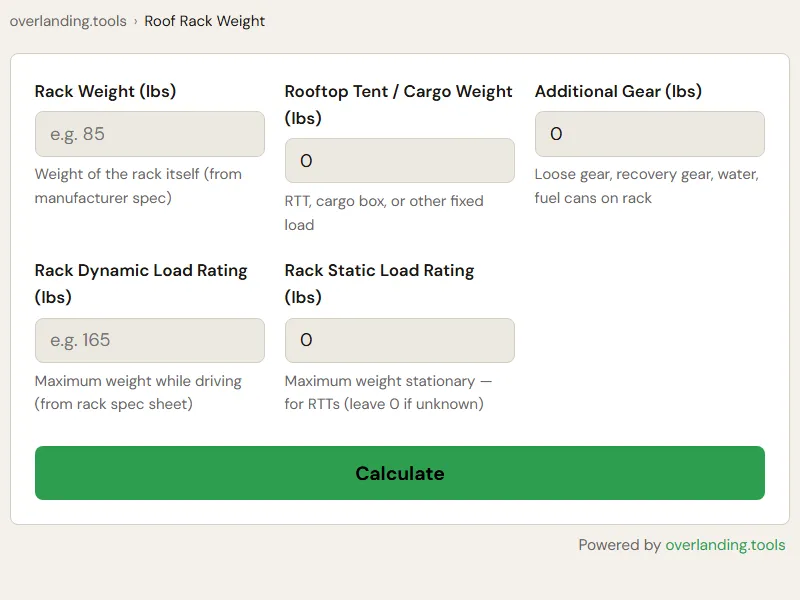
Every roof rack system carries two critical specifications that most overlanders overlook: the dynamic load rating and the static load rating. The dynamic rating is the maximum weight the rack can safely carry while the vehicle is moving — it accounts for road vibration, potholes, and the dynamic forces of acceleration and braking. The static rating, typically four times the dynamic rating, applies only when the vehicle is parked and the weight is not subject to driving forces. A rack rated at 165 lbs dynamic and 661 lbs static can legally carry a 145-lb rooftop tent for camping, but you are over the dynamic limit the moment you drive away with the tent deployed.
The reason dynamic ratings are so much lower is inertia. A 165-lb rack load at highway speed carries substantial kinetic energy — when you hit a pothole or make a sudden swerve, the roof load exerts forces many times its static weight on the mounting points, crossbars, and roof rails. Roof rail attachment points are typically the weakest link; repeated overloading fatigues the metal and can cause sudden failure at speed. Always use the dynamic rating as your driving limit.
Center of Gravity and Rollover Risk
Even within rated limits, roof loads meaningfully affect handling. Weight placed high on the vehicle raises the center of gravity, increasing body roll in corners and making the vehicle more susceptible to rollover on off-camber trail surfaces. The effect is most pronounced on tall vehicles like full-size SUVs and pickup trucks with extended cabs. A 250-lb roof load on a mid-size SUV can increase the rollover risk in emergency maneuvers by a measurable margin. This is not a reason to avoid roof racks — it is a reason to load them thoughtfully and adjust your driving accordingly.
RTT Weight and Crossbar Selection
Rooftop tents are the most weight-intensive roof rack load in overlanding. A typical soft-shell RTT weighs 100–160 lbs; hard-shell models range from 120–200 lbs. Add the weight of the rack itself and a sleeping bag or two, and it is easy to exceed 300 lbs total. Most factory roof rails and crossbars are not rated for this load while driving. Purpose-built overlanding crossbars from brands like Thule, Yakima, and Rhino-Rack publish explicit static and dynamic ratings — use only crossbars that specify RTT compatibility.
Vehicle Roof Rating vs Rack Rating
Your vehicle's roof structure also has a load rating, found in the owner's manual. Always use the lower of the vehicle roof rating or the rack's rating — the weakest link in the chain determines the safe limit. Many compact crossovers have roof ratings of 100–150 lbs, below the dynamic rating of popular aftermarket racks. In this case, the vehicle roof rating is the governing limit, regardless of what the rack spec sheet says.