Every truck, SUV, and Jeep has a Gross Vehicle Weight Rating (GVWR) — a number stamped on your door jamb sticker that most overlanders never look at until they've already spent $15,000 on modifications. GVWR is the maximum total weight your vehicle is certified to carry: the vehicle itself, every drop of fluid, every passenger, every bolt of armor, every ounce of camping gear, and the tongue weight of any trailer. It is not a suggestion. It is a structural, braking, and tire load limit set by engineers who calculated exactly how much stress the frame, axles, and suspension components can reliably handle.
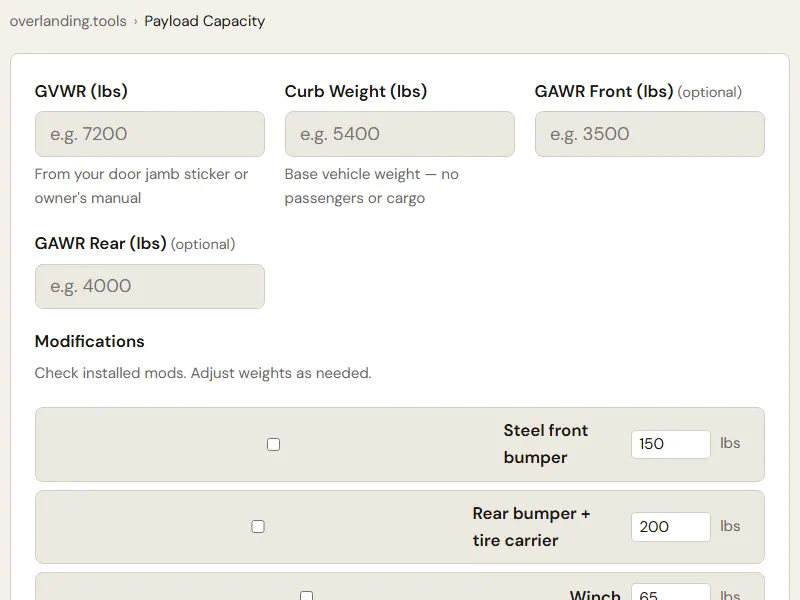
Payload capacity is simply GVWR minus curb weight — the difference is what you have left to work with. A truck with a 7,200-lb GVWR and a 5,400-lb curb weight has 1,800 lbs of payload. That sounds generous until you start adding it up: a steel front bumper (150 lbs), rear bumper with tire carrier (200 lbs), winch (65 lbs), roof rack (60 lbs), rooftop tent (150 lbs), rock sliders (75 lbs), and skid plates (60 lbs) consume 760 lbs before you've packed a single sleeping bag. Add two passengers at 165 lbs each, 20 gallons of fuel (126 lbs), 10 gallons of water (83 lbs), and 200 lbs of gear, and you've used 1,499 lbs — leaving only 301 lbs of margin. Hook up a 3,000-lb trailer with 300 lbs of tongue weight and that margin disappears entirely.
Why Overlanders Routinely Exceed Payload
The overlanding community has normalized weight additions that incrementally destroy payload margins. Each modification seems reasonable in isolation — a bumper for protection, a winch for recovery, an RTT for convenience. But the compounding effect is devastating. An overlander who installs every common modification before their first serious trip may be 500–800 lbs over GVWR before they've loaded food, water, or a sleeping bag. Factory payload ratings for popular overlanding platforms are often 1,400–1,800 lbs, which sounds like a lot until the build sheet gets long.
Consequences of Exceeding Payload
Driving an overloaded vehicle is dangerous in ways that compound with speed and terrain. Braking distances increase dramatically — the braking system is sized for the rated weight, not 20% more. Tire load ratings are exceeded, making blowouts more likely, especially on rough terrain where impacts add dynamic loading. Suspension components fatigue faster, leading to premature failure of shocks, bushings, and springs. Electronic stability control and ABS systems calibrated for normal weight become less effective or give false confidence at abnormal weights.
Beyond safety, the legal and financial consequences are real. GVWR exceedance voids your factory warranty. In most jurisdictions, operating an overloaded vehicle on public roads is a citable offense, and commercial vehicle weight laws can apply even to personal trucks on certain roads. More critically, if you're in an accident and investigators determine your vehicle was overloaded, your insurance carrier has grounds to deny the claim — leaving you personally liable for all damages and medical costs.
GAWR: Per-Axle Limits
GVWR is the total weight limit, but Gross Axle Weight Rating (GAWR) is the per-axle limit — front and rear. A vehicle can be within GVWR but still exceed GAWR if the load is concentrated on one axle. Overlanding builds frequently shift weight rearward: rear bumpers, spare tires, water tanks, and rear cargo all add rear-axle load. A heavy rooftop tent on a short wheelbase SUV can push rear GAWR limits even when total GVWR is within spec. The only way to know for certain is to weigh each axle separately on a certified scale.
When to Weigh at a Certified Scale
Any time your calculated payload usage exceeds 80% of capacity, you should weigh your vehicle at a certified truck scale before a major expedition. Truck stops, feed stores, and recycling facilities often have certified scales available for a few dollars. Weigh first with a full fuel tank and all gear loaded exactly as you'd depart. Weigh each axle separately to check GAWR compliance. If you're regularly near limits, a portable axle scale (like the Sherline) lets you weigh at home and optimize load distribution before every trip.