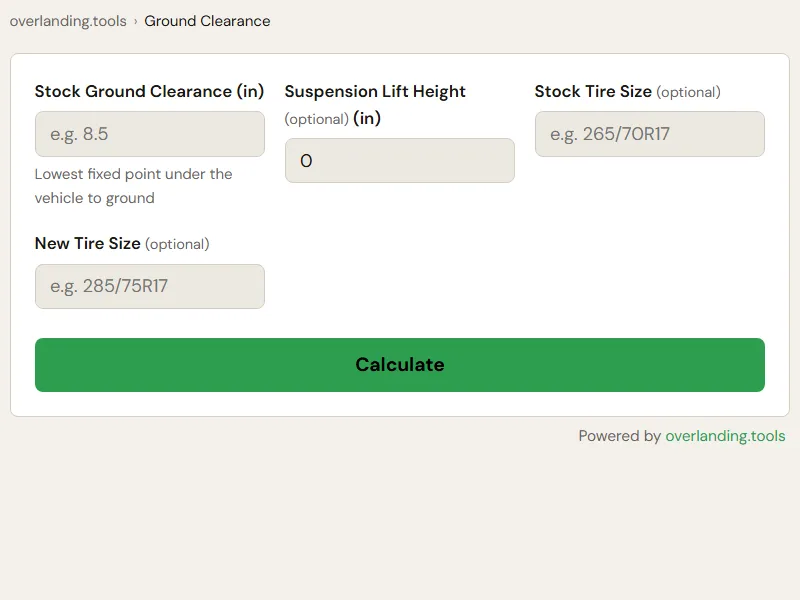
Ground clearance is measured from the lowest fixed point on your vehicle — typically the differential pumpkin, transfer case skid plate, or exhaust pipe — to the ground below. It is not the same as ride height, and it does not change uniformly across the vehicle. Your front differential may have 8.5 inches of clearance while your rear differential has 9 inches and your transfer case skid sits at 10 inches. The limiting factor in any obstacle crossing is always the lowest point.
A suspension lift adds spring or coilover travel between the axle and the frame, raising the body and frame relative to the axle. On a solid-axle vehicle (Wrangler, 4Runner, Land Cruiser, etc.) the differential is bolted to the axle housing, and that housing always sits one tire-radius above the ground — so a suspension lift does not raise the differential or your lowest underbody point. Only larger tires raise the axle and diff. What the lift buys you is body and frame clearance, suspension travel, and the room to fit those larger tires. Independent front suspension is different: the front differential is bolted to the frame, so a lift does raise it — until the inner CV joints and axle shafts become the new limiting point. Always identify your actual lowest point before and after any modification.
How Tire Size Affects Clearance
Every inch of additional tire diameter contributes half an inch of ground clearance — the radius increase raises the axle centerline, and with it the differential, by that amount. Moving from a 31.6-inch diameter stock tire (265/70R17) to a 33.8-inch diameter (285/75R17) adds 1.1 inches of clearance under the axle from the tire change alone. On a solid axle this is the real clearance gain: the differential is your lowest point, and only bigger tires raise it. A 3-inch suspension lift on top adds body and frame clearance and makes room for the larger tires, but it does not lift the diff any higher off the ground.
The Importance of Skid Plates
A suspension lift and larger tires expose more of your underbody to trail obstacles. The differential pumpkins, oil pan, transfer case, and fuel tank that were previously protected by lower clearance and factory skid plates are now more vulnerable to direct hits on rocks and ledges. Every serious overland build that benefits from a lift should also include a comprehensive set of skid plates. Skid plates add modest weight — typically 50–100 lbs for a full set — but they protect components that cost thousands of dollars to replace.
Trail Clearance Ratings Explained
The clearance thresholds used in this calculator reflect real-world trail requirements documented across overlanding and 4WD communities. Under 7 inches is marginal even for maintained gravel roads with embedded rocks. At 9–10 inches, most forest service roads, moderate rock ledges, and typical overlanding terrain is accessible. At 11 inches and above, serious technical trails and rock crawling become realistic with appropriate driving technique and skid plate protection. On a solid axle, reaching these numbers under the differential means fitting larger tires — neither a suspension lift nor a body lift raises the diff itself, so a lift alone creates the illusion of clearance without actually raising your lowest underbody point.