Running out of fuel in the backcountry is not a roadside inconvenience — it can be a genuine emergency. Unlike a highway breakdown, you may be hours from cell service, miles from the nearest town, and completely dependent on your own resources. Careful fuel planning before every trip is one of the most fundamental overlanding skills, yet it's often underestimated by newer travelers who are accustomed to the density of gas stations on paved roads.
The first challenge is understanding your actual fuel consumption off-road. The off-road MPG penalty is real and significant: most vehicles lose 20–40% efficiency compared to highway driving. A stock truck that returns 20 MPG on the interstate may achieve only 12–15 MPG on maintained dirt roads, and drop to 8–12 MPG on technical terrain. Contributing factors include low-speed engine load (engines are inefficient at crawling speeds), increased rolling resistance from soft terrain, 4WD and low-range engagement, and aerodynamic drag from accessories like roof racks, snorkels, and larger tires.
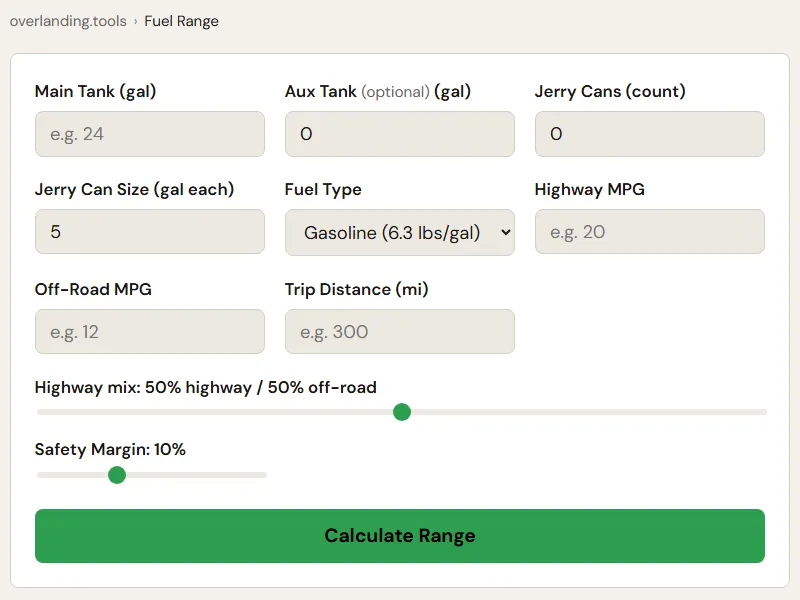
Calculating range for a mixed trip requires the harmonic mean, not the arithmetic mean, of your efficiency figures. If you simply average 20 MPG highway and 12 MPG off-road, you get 16 MPG — but this overstates your real range. The correct approach weights each leg by its share of total distance. Sixty percent highway at 20 MPG and 40% off-road at 12 MPG yields a true mixed MPG of approximately 15.8 MPG. The difference matters most on long-range expeditions where even a 5% error compounds across hundreds of miles.
Jerry can safety is non-negotiable. Carrying fuel inside the passenger compartment is illegal in most jurisdictions and extremely dangerous under any circumstances — fumes accumulate, containers can rupture, and a collision or rollover turns your cab into a fireball. All supplemental fuel must ride externally: on a rear bumper carrier, roof rack mount, or bed-mounted bracket. Use only UN-approved or DOT-rated containers rated for the fuel type you carry. Never transport fuel in unapproved plastic jugs or previously used containers. Inspect seals and caps before every trip.
Fuel weight has a direct and often-overlooked impact on payload capacity. Gasoline weighs approximately 6.3 lbs per gallon; diesel approximately 7.1 lbs per gallon. A 30-gallon aux tank full of diesel adds roughly 213 lbs of fuel alone, plus the tank's own weight of 40–80 lbs depending on construction. Add a set of four 5-gallon jerry cans and you have another 142 lbs of diesel — or 126 lbs of gasoline. That weight comes directly out of your payload budget alongside gear, passengers, water, and recovery equipment. Overloading your vehicle affects handling, braking, suspension longevity, and frame stress.
The safety margin concept is straightforward but easy to rationalize away when planning a route. A 10% margin means you budget to arrive at your destination with 10% of total capacity remaining. In the American Southwest desert or Australian outback, experienced overlanders recommend 20–25% margins to account for unexpected detours, sand driving that decimates efficiency, or fuel quality issues at remote stations. The cost of carrying extra fuel is low; the cost of running dry in a remote canyon is high.