Lifting your truck or SUV changes more than just ground clearance. When you add suspension lift — whether through a leveling kit, spacer, or full lift kit — you alter the geometry of every moving component in your front suspension. Two of the most critical effects are caster angle change and increased CV/U-joint operating angle. Ignore either one and you will pay for it in premature part wear, handling problems, or outright joint failure on the trail.
Caster angle is the forward or backward tilt of the steering axis as viewed from the side. Positive caster (top of the steering axis tilted toward the rear of the vehicle) provides straight-line stability and self-centering steering feel. Factory engineers tune caster carefully — most modern trucks and SUVs run 3–7° of positive caster. When you add a suspension lift, the lower control arm drops relative to the frame, and the geometry that created that positive caster is disrupted. The result is reduced positive caster, sometimes going negative in severe lifts. The driver experiences this as wandering at highway speeds, a need to constantly correct steering, and a "loose" front end feel.
CV (constant velocity) and U-joints convert rotational power from the differential to the wheel while allowing the suspension to travel. Both joint types have angular limits. At shallow angles, they run cool and last for years. As the operating angle increases, the joint must work harder on each rotation to maintain constant velocity output — generating heat, vibration, and accelerated wear. The widely cited Spicer and Dana specifications set 25° as the maximum for continuous street use, and 28° as the absolute maximum under any conditions. Above 25°, expect noticeably shorter joint life. Above 28°, expect rapid failure, vibration under load, and potential for catastrophic separation on technical terrain.
For IFS vehicles, a suspension lift raises the body relative to the differential, which sits lower in the frame and cannot move. The half-shaft — which runs from the differential to the wheel — must now operate at a steeper angle. A 3-inch lift on a vehicle with 14-inch half-shafts creates roughly a 12° CV angle. That's manageable. A 6-inch lift on the same vehicle pushes past 23°, approaching the safe limit. Add worn ball joints or alignment that's slightly off and you can tip past 25° easily.
The two main correction strategies differ in both cost and completeness. Caster correction shims are angled wedges that tilt the axle or strut to restore positive caster angle. They are inexpensive and easy to install. However, they do not change the length or pivot geometry of the control arms, so they do not address the CV angle problem. For solid axle vehicles on smaller lifts, shims are often adequate. For IFS vehicles on moderate to large lifts, shims are a partial fix at best.
Extended upper control arms (UCAs) are the geometrically correct solution for IFS vehicles. By moving the upper ball joint outward and often upward, UCAs restore the factory suspension geometry at the new ride height. This simultaneously corrects caster angle and reduces the CV operating angle — addressing both problems with one part. Quality UCAs from companies like SPC, Camburg, or Icon use longer arms with improved ball joints and are engineered for specific vehicle platforms. They cost more than shims but are the only way to properly sort the geometry on a seriously lifted IFS truck.
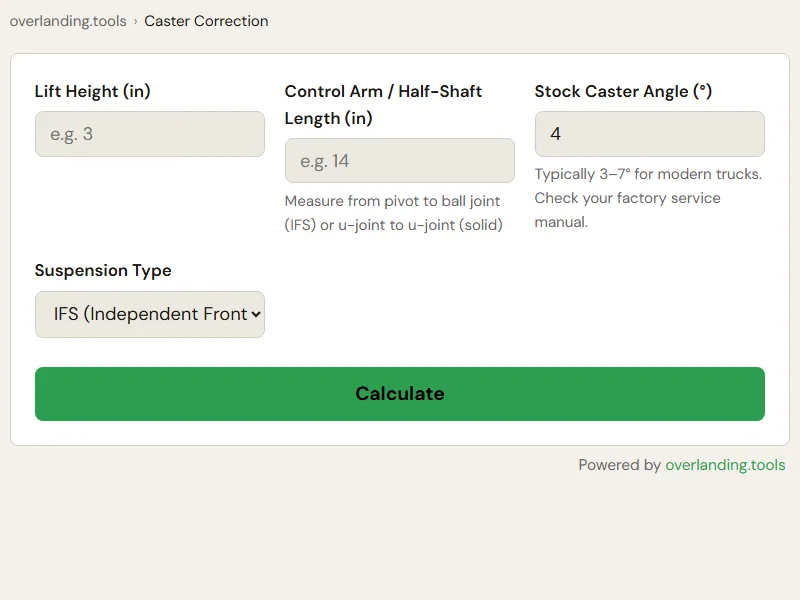
Use this calculator as a first-pass check. Enter your lift height, half-shaft or control arm length, stock caster angle, and suspension type. The calculator applies standard geometry to estimate your new CV operating angle and how much caster correction you need. If results show CV angle above 25°, prioritize extended UCAs before putting miles on the vehicle.