Building a reliable 12V electrical system is one of the most rewarding overlanding projects — and one of the most commonly under-built. Most rigs end up with an undersized battery bank after the builder discovers the actual power draw of a 12V fridge running continuously in the heat. Understanding the core concepts before you buy anything saves you from doing the build twice.
Depth of Discharge: The Hidden Multiplier
Battery capacity ratings are theoretical maximums, not usable numbers. Flooded lead-acid and AGM batteries should only be discharged to 50% of their rated capacity to maintain long cycle life. Drawing an AGM battery to 80% or 100% on a regular basis dramatically shortens its life — a 100Ah AGM might handle 200 cycles to 80% DoD but 500+ cycles to 50% DoD.
LiFePO4 (lithium iron phosphate) chemistry changes this equation. A quality LiFePO4 battery can safely discharge to 80% depth of discharge while maintaining thousands of cycles. That means a 100Ah LiFePO4 delivers 80Ah of usable power vs. 50Ah from a 100Ah AGM. To replace 200Ah of usable capacity, you need a 250Ah LiFePO4 bank vs. a 400Ah AGM bank — nearly half the weight and significantly less volume.
Fridges: The Dominant Load
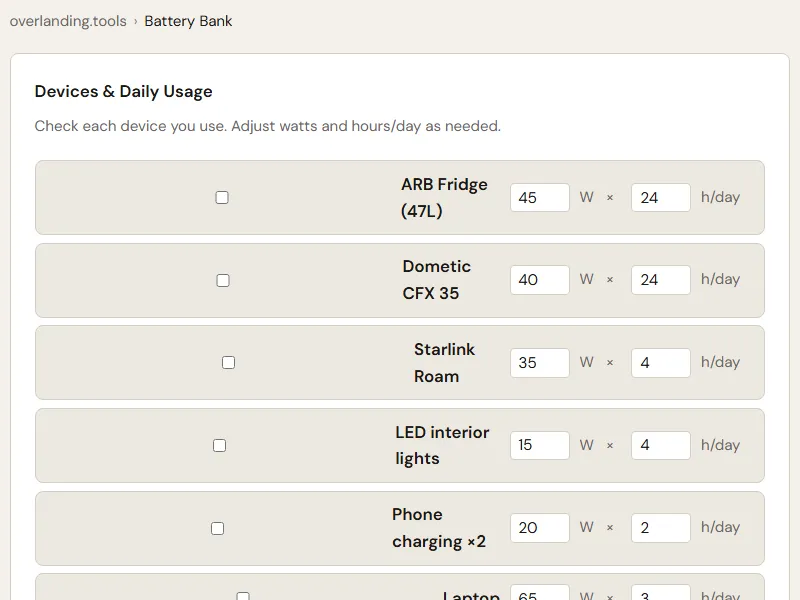
A 12V compressor fridge is typically the single largest draw in an overlanding build — but it cycles on and off rather than running continuously. A 47-liter ARB fridge pulls roughly 45W while the compressor runs, yet at a ~35% duty cycle it averages closer to 350–400 Wh per day, not the ~1,080 Wh a constant 45W draw would imply. (This calculator applies that duty factor for you.) It's still usually more than the rest of your camp loads combined, so size your battery bank for the fridge first, then add everything else.
Ambient temperature matters significantly. A fridge working hard in 95°F desert heat may draw 30–40% more power than the same fridge in moderate temperatures. If you camp in the desert, add a 30% buffer to fridge load estimates.
Solar Sizing and the 85% Efficiency Factor
Solar panels are rated at Standard Test Conditions (STC): 1,000W/m² irradiance and 25°C panel temperature. Real-world output is lower due to heat, wiring losses, charge controller efficiency, and non-ideal sun angles. A derating factor of 0.85 (85% system efficiency) is a practical estimate for a well-installed roof-mounted panel with an MPPT charge controller.
Peak sun hours are the key variable. A location with 5 peak sun hours means the equivalent of 5 hours of full STC irradiance per day. The American Southwest averages 5–6 peak sun hours in summer; the Pacific Northwest may get 3–4; Alaska in summer can exceed 7. A 200W panel in 4 peak sun hours at 85% efficiency produces: 200 × 4 × 0.85 = 680Wh per day — enough to cover a modest fridge and some electronics.
DC-DC Chargers vs. VSRs
A voltage-sensitive relay (VSR) connects your house battery to the alternator when starter battery voltage rises above a threshold. It's simple, inexpensive, and works adequately for lead-acid house batteries. The problem with modern vehicles is that smart alternators reduce voltage to save fuel — they no longer provide a steady 14.4V charge, so the VSR may open and close unpredictably, and the charging profile is never optimized.
A DC-DC charger (also called a battery-to-battery charger or B2B charger) solves both problems. It draws from the starter battery at whatever voltage the alternator provides and outputs a proper multi-stage charge profile to the house battery — bulk, absorption, and float phases. REDARC's BCDC series is a popular choice because it also accepts a solar input, allowing the charge controller and alternator charger to work simultaneously through a single unit.
For LiFePO4 house batteries: always use a DC-DC charger. A VSR connected to a smart alternator will undercharge LiFePO4 cells and may never reach absorption voltage, leaving you with 70–80% charge at best.
Putting It Together
A practical overlanding electrical system for weekend to week-long trips typically includes: 200–300Ah LiFePO4, 200W roof-top solar, and a 25A DC-DC charger. This combination handles a fridge, lighting, phone charging, and occasional laptop use with 1–2 days of cloudy-weather buffer. Longer expeditions or high-draw items like Starlink and inverter loads push toward 400Ah+ and 400W solar.
Wire sizing is outside the scope of this calculator but is equally important: undersized wiring creates voltage drop that robs power and creates fire risk. Use Blue Sea Systems' online circuit wizard or the ABYC standards for marine electrical wiring as your guide — marine standards are more rigorous than automotive and appropriate for overlanding builds.