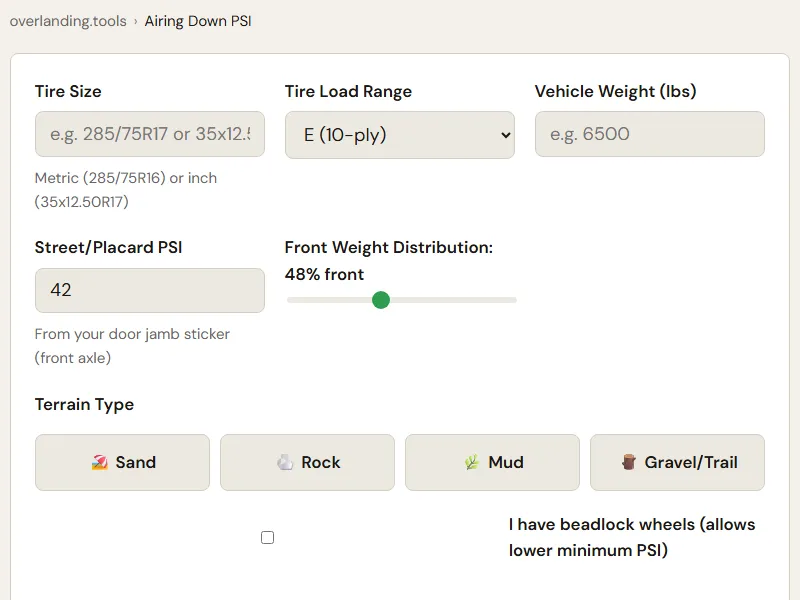
Tire pressure is the single most impactful adjustment you can make before hitting the trail. A pneumatic tire's contact patch — the footprint touching the ground — is determined by one simple relationship: vehicle weight divided by tire pressure. Lower the pressure, spread the patch. Spread the patch, gain traction.
On sand, a large contact patch lets the tire float on the surface rather than dig in. Aggressive tread patterns and high PSI create a narrow, deep rut. Drop to 12–15 PSI with a Load Range E tire and that same tread suddenly presents three times the surface area — enough to stay on top of even soft beach sand. Jonathan Hanson and the Overland Expo curriculum recommend starting at 15 PSI on sand and working lower until the tire just starts to balloon visibly at the sidewall.
Rock crawling is more nuanced. You still want lower PSI for traction and to let the tire conform around rocks, but too low risks a pinch flat or de-bead on a sharp ledge. The sidewall needs enough pressure to resist the puncture. Most experienced rock crawlers settle on 18–22 PSI for technical boulder fields without beadlocks, and 14–16 PSI with beadlock wheels. The TRA (Tire and Rim Association) load/inflation tables show that a Load Range E tire at 20 PSI still carries over 1,700 lbs — plenty for most rigs at low speed.
Mud requires a balance. Very low pressure risks packing mud into the tread (reducing self-cleaning ability), while higher pressure keeps the tire spinning to clear itself. Most overlanders find 18–22 PSI works well for mud, combined with aggressive tires designed to fling material out of the lugs.
Load range determines how stiff the tire carcass is and the maximum inflation pressure. Load Range C tops out around 50 PSI, Load Range E at 80 PSI, Load Range F at 95 PSI. A heavier vehicle with a stiffer-carcass tire needs to air down more aggressively to achieve the same contact patch expansion as a lighter vehicle with a softer tire. This is why vehicle weight is part of this calculator's inputs.
De-beading is when the tire bead separates from the rim — the tire literally falls off the wheel. This can happen at low PSI under lateral load, like when a vehicle leans sideways on a slope. Without beadlock wheels (which mechanically clamp the bead to the rim), most experts advise staying above 15 PSI to prevent de-beading. Below 12 PSI without beadlocks is generally considered unsafe on any terrain.
Always carry a portable compressor. Driving at off-road PSI on pavement is dangerous: the tire runs hot, degrades rapidly, and can fail catastrophically at highway speed. Re-inflate to door jamb placard pressure before returning to road. As a rough rule, every 10 PSI of under-inflation on pavement cuts tire life by 25% and increases heat buildup significantly.